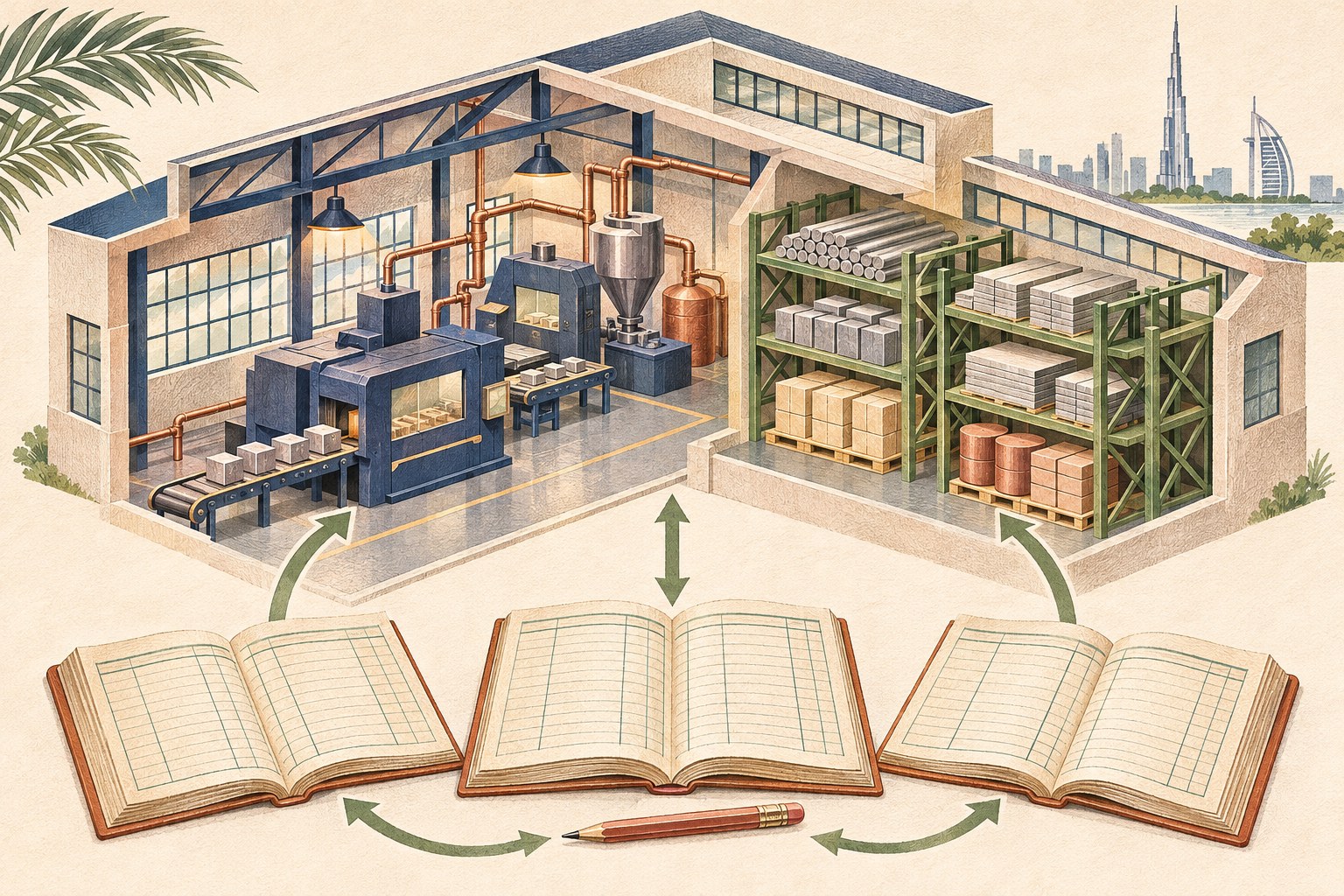
RAKEZ manufacturers should prepare a consistent set of licence, production and accounting records before completing industrial-data requests. Start with the live portal instructions, agree the reporting period and reconcile each figure to supporting records. A balanced trial balance alone does not explain what a factory produces or how its stock moves.
Published 6 November 2026. This article explains the practical record-preparation implications of an official announcement dated 30 October 2026.
What did RAKEZ announce?
In its 30 October 2026 announcement, RAKEZ confirmed integration with the national registers and an enhanced customer portal for collecting additional industrial-company information. An awareness workshop with the Ministry of Industry and Advanced Technology and the Ministry of Economy and Tourism explained submissions and data use.
The National Industrial Register brings together licensed industrial-company data from mainland and free zones across all seven emirates. The announcement describes an operational development; it does not state a universal company submission deadline or a separate legal effective date. Check your own portal notice and obtain clarification from RAKEZ where needed.
Which records should your team prepare?
The following is Rasif’s recommended internal preparation checklist, not an official list of mandatory portal fields. Use it to organise evidence, then supply only what the current request requires.
- Company identity: current licence, legal name, licence number, approved activities and facility details. Keep each legal entity separate, even when several companies share an owner.
- Production records: product descriptions, production logs and the units used by operations. Document whether figures describe actual output or available capacity; these are different measures.
- Inventory evidence: raw materials, work in progress and finished goods schedules, supported by stock counts and movement records.
- Financial records: a reviewed trial balance, sales and purchase ledgers, fixed-asset register and relevant supporting invoices for the requested period.
- Responsibility record: identify who prepares each figure, who checks it and who approves submission.
How do you reconcile factory data with the books?
First, agree dates and definitions. Calendar-year output cannot be compared directly with a financial report covering a different period. Similarly, kilograms, litres, cartons and individual units need clear conversion rules. Save the calculation behind any conversion rather than relying on a staff member’s memory.
Next, reconcile physical quantities separately from financial values. A practical stock check starts with opening quantity, adds production or receipts, and subtracts dispatches, consumption and documented losses. Compare the result with the closing count and investigate differences. The accounting valuation is a separate exercise: a quantity difference and a costing difference need different explanations.
Illustrative example: a packaging manufacturer produces cartons but records some deliveries in bundles. Operations reports 12,000 cartons while a dispatch report shows 1,000 bundles. If each bundle contains 12 cartons, the quantities may agree. The team should retain the conversion evidence before treating the difference as missing stock. These figures illustrate a checking method; they are not regulatory thresholds.
Finally, maintain an exceptions list. Record the unexplained difference, source document, responsible person and proposed correction. Do not change ledger balances merely to force agreement with a portal figure. Correct supported errors through the normal accounting review process.
What should happen before and after submission?
Download or capture the current instructions and record the period requested. Ask your RAKEZ contact about ambiguous definitions or unavailable data before entering an unsupported estimate. Have operations and finance review the completed dataset together, with management approving the final version.
After submission, retain the submitted information, underlying schedules and acknowledgement in a controlled company folder. If information needs correction later, follow the authority’s current process and preserve the original version with a clear explanation of the change. This creates a useful record for future queries and internal handovers.
Frequently asked questions
Does this announcement set a new tax rate or filing deadline?
No new tax rate or tax-return deadline is stated in this RAKEZ announcement. It concerns industrial-data integration. Review tax obligations separately rather than interpreting a portal update as a tax concession.
Should every service or trading business submit industrial data?
The announcement concerns industrial companies. A business should check its licensed activities and the request addressed to it; this article does not establish a blanket filing obligation for all RAKEZ clients.
Can Rasif help prepare the records?
Rasif can help organise supporting schedules and review reconciliations through its accounting and bookkeeping services. For questions about activities or facilities, explore our RAKEZ business setup support. Scope and any submission assistance are agreed separately.
Arrange a free initial consultation
Book a free initial consultation with Rasif Accountants FZ-LLC. Bring your current licence, the portal request and a sample of your production and accounting reports so we can identify the preparation work needed.
Email info@rasifaccountants.com or call +971 55 770 9776 / +971 7 204 1565.
Official source checked on 6 November 2026: RAKEZ: National industrial data integration, 30 October 2026. The checklist and example above are practical recommendations, not additional government requirements.